

Here is vs Here are
| Here is | Here are | |
|---|---|---|
| Part of speech | Singular verb, Singular nouns | Plural verb, Plural nouns |
| Meaning | Introduces one person or thing | Introduces multiple people or things |
| Example | Here is your book. | Here are your books. |
| Memory trick | One thing | Many things |
“Here is” and “here are” are both grammatically correct, but they are used in different situations. The correct choice depends on whether the noun or subject being introduced is singular or plural.
Use “here is” before a singular noun or an uncountable noun. Use “here are” before a plural noun.
For example:
- Here is your book.
- Here are your books.
This confusion often occurs in everyday conversations, emails, professional writing, and introductions. Understanding the difference will help you choose the correct expression and write more naturally.
Here Is or Here Are the Details: Which Is Correct?
“Here are the details” is correct because “details” is a plural noun and requires the plural verb “are.”
Use “here is the detail” when referring to one specific piece of information.
Examples:
- Here are the details of the meeting.
- Here are the details you requested.
- Here is the detail I wanted to share.
- Here is one important detail to remember.
Quick Tip: Use “here are the details” for multiple pieces of information and “here is the detail” for one.
Meaning and Definition
Meaning of Here Is
“Here is” is an expression used to introduce, present, or draw attention to one person, object, place, or idea. It is also used with uncountable nouns.
It commonly appears when giving someone something, sharing information, or pointing out a particular thing.
Examples:
- Here is your coffee.
- Here is the document you requested.
- Here is my new phone.
- Here is some useful advice.
Definition of Here Is
“Here is” is a phrase consisting of the adverb “here” and the singular present form of the verb “be” (is).
It introduces a singular subject or an uncountable noun that follows the verb. It is commonly used in sentences where the subject comes after the verb.
For example, in “Here is your invitation,” the subject is “your invitation,” and the verb “is” agrees with it.
Meaning of Here Are
“Here are” is an expression used to introduce, present, or draw attention to two or more people, objects, places, or ideas.
It is commonly used when giving someone multiple things, presenting a list, or pointing out several items.
Examples:
- Here are your keys.
- Here are the documents you requested.
- Here are three reasons to exercise.
- Here are the students waiting outside.
Definition of Here Are
“Here are” consists of the adverb “here” and the plural present form of the verb “be” (are).
It introduces a plural subject that follows the verb. The expression is used when referring to multiple people or things.
For example, in “Here are your books,” the subject is “your books,” and the plural verb “are” agrees with it.
Main Difference
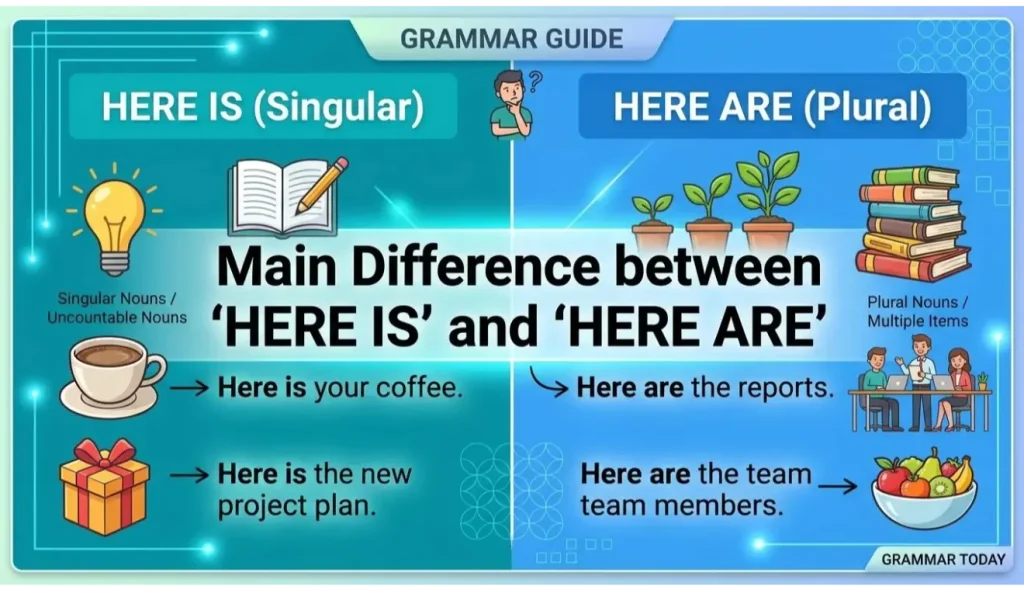
The main difference between “here is” and “here are” is subject-verb agreement. The choice depends on whether the subject being introduced is singular or plural.
| Feature | Here Is | Here Are |
| Verb form | Singular | Plural |
| Subject | Singular noun | Plural noun |
| Uncountable nouns | Yes | No, in the ordinary sense |
| Main purpose | Introduces one thing | Introduces multiple things |
| Example | Here is my bag. | Here are my bags. |
1. Singular and Plural Nouns
Use “here is” when introducing one person or thing.
- Here is my brother.
- Here is the correct answer.
- Here is a beautiful picture.
Use “here are” when introducing more than one person or thing.
- Here are my brothers.
- Here are the correct answers.
- Here are some beautiful pictures.
2. Countable and Uncountable Nouns
Countable nouns can be counted individually, while uncountable nouns refer to things that are not normally counted as separate units.
Use “here is” with uncountable nouns.
- Here is some information.
- Here is your luggage.
- Here is the equipment.
- Here is some good news.
Use “here are” with plural countable nouns.
- Here are some suggestions.
- Here are the bags.
- Here are the new computers.
Remember that words such as information, advice, furniture, luggage, and equipment are generally uncountable in standard English. They take singular verbs even when they refer to multiple items.
3. The Subject Determines the Verb
An important point is that the word “here” does not determine whether you should use is or are. The noun or noun phrase following the verb determines the correct form.
Consider these examples:
- Here is a box of chocolates.
- Here are several boxes of chocolates.
In the first sentence, the subject is “a box,” which is singular. The word “chocolates” does not change the agreement.
In the second sentence, “boxes” is plural, so “are” is correct.
Which One Is Correct?
Both “here is” and “here are” are correct standard English expressions. Neither is universally better or more correct than the other.
The correct choice depends on the subject.
- Use here is for singular subjects and uncountable nouns.
- Use here are for plural subjects.
Compare:
Correct
- Here is your ticket.
- Here are your tickets.
- Here is the information.
- Here are the details.
Incorrect
- Here are your ticket.
- Here is your tickets.
- Here are the information.
- Here is the details.
The easiest way to check your sentence is to identify the noun being introduced and determine whether it is singular, plural, or uncountable.
Grammar and Usage
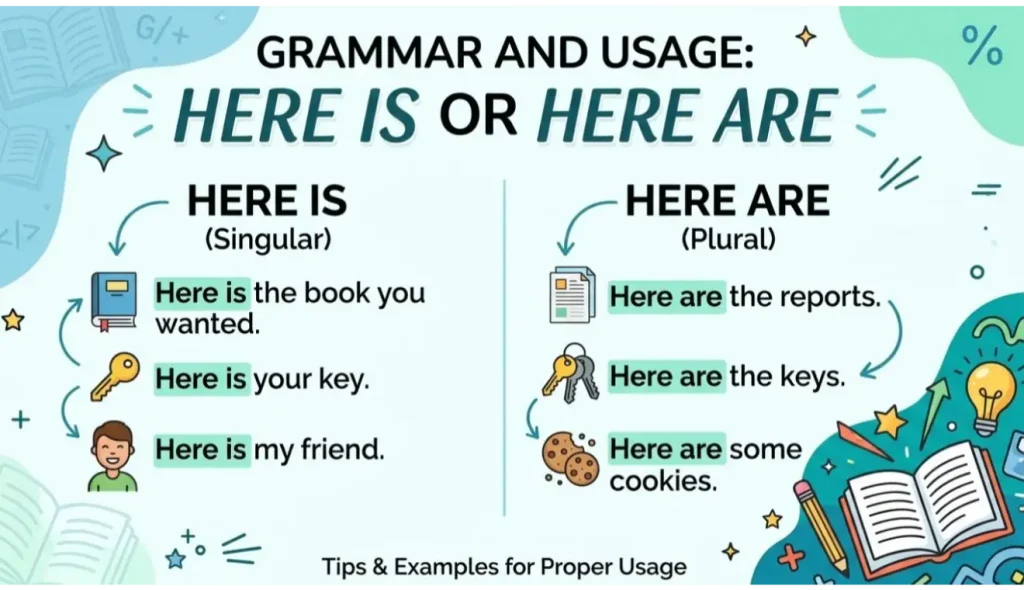
Understanding the grammar behind these expressions makes it easier to use them correctly.
1. Subject-Verb Agreement
Subject-verb agreement means that a verb must match its subject in number.
In ordinary sentences, the subject often comes before the verb:
- The book is here.
- The books are here.
However, sentences beginning with “here” can place the verb before the subject:
- Here is the book.
- Here are the books.
This reversed arrangement is sometimes called subject-verb inversion. The same agreement rule still applies.
2. Singular and Plural Verb Forms
The verb “be” has different forms depending on its subject.
- Singular: is
- Plural: are
Examples:
- Here is my friend.
- Here are my friends.
- Here is the solution.
- Here are the solutions.
3. Uncountable Nouns
Uncountable nouns generally take singular verbs, even when they describe a large amount or several related things.
Examples:
- Here is some water.
- Here is the advice you need.
- Here is the furniture for your office.
- Here is all the information.
Do not use “here are” simply because the uncountable noun refers to several items.
4. Using Here Is and Here Are in Questions
Both expressions can also appear in questions, although their structure may differ depending on what you want to ask.
Examples:
- Is your book here?
- Are your books here?
- Here is the problem, isn’t it?
- Here are the documents, aren’t they?
The question tags in the last two examples agree with the singular and plural subjects, respectively.
5. Contractions: Here’s and Here Are
“Here’s” is the contraction of “here is.”
Examples:
- Here’s your order.
- Here’s the information.
- Here’s my suggestion.
In standard formal writing, use “here are” when introducing plural nouns.
For example:
- Here are your files. (Standard)
- Here’s your files. (Common in informal speech, but not recommended in formal writing.)
Although speakers sometimes use “here’s” before plural nouns in casual conversation, it is better to maintain standard subject-verb agreement in professional and academic writing.
content.byui.edu+2
How to Use Here Is and Here Are
Knowing a few practical sentence patterns can help you choose the correct expression in everyday communication.
When to Use Here Is
Use “here is” in these situations:
1. Introducing one person or thing
- Here is my new laptop.
- Here is your appointment confirmation.
- Here is the package you ordered.
2. Presenting information
- Here is the information you requested.
- Here is some useful advice.
- Here is the latest update.
3. Introducing a singular idea or explanation
- Here is why I disagree.
- Here is the main reason for the delay.
- Here is an example to help you understand.
When to Use Here Are
Use “here are” in these situations:
1. Introducing multiple people or things
- Here are my friends.
- Here are the new employees.
- Here are your shoes.
2. Presenting lists or options
- Here are five ways to improve your writing.
- Here are three possible solutions.
- Here are some useful resources.
3. Sharing multiple documents or details
- Here are the documents for your application.
- Here are the details of the meeting.
- Here are the instructions you need to follow.
Examples
The following examples demonstrate how to use both expressions correctly in everyday and professional situations.
Examples of Here Is
- Here is the book you asked me to bring.
- Here is your seat near the window.
- Here is the answer to your question.
- Here is my suggestion for the project.
- Here is the report you requested yesterday.
- Here is some fresh water for you.
- Here is the reason behind the decision.
- Here is your chance to make a difference.
- Here is the information about the upcoming event.
- Here is a simple way to solve this problem.
Examples of Here Are
- Here are the books you wanted to borrow.
- Here are your keys on the kitchen table.
- Here are the answers to all your questions.
- Here are some interesting facts about English.
- Here are the files you need for the meeting.
- Here are three reasons why exercise is important.
- Here are the students participating in the competition.
- Here are some useful tips for improving your writing.
- Here are the changes we discussed yesterday.
- Here are the available options for your project.
Common Mistakes
Writers and English learners sometimes confuse “here is” and “here are” because the subject appears after the verb. Here are some common mistakes and their corrections.
1. Using Here Is With Plural Nouns
Incorrect: Here is your new shoes.
Correct: Here are your new shoes.
Why? The noun “shoes” is plural, so it requires the plural verb “are.”
2. Using Here Are With Singular Nouns
Incorrect: Here are your invitation.
Correct: Here is your invitation.
Why? “Invitation” refers to one thing, so the singular verb “is” is necessary.
3. Confusing Uncountable Nouns
Incorrect: Here are some information about the course.
Correct: Here is some information about the course.
Why? “Information” is an uncountable noun in standard English and takes a singular verb.
4. Choosing the Verb Based on the Nearest Noun
Incorrect: Here are a box of chocolates.
Correct: Here is a box of chocolates.
Why? The subject is “a box,” not “chocolates.” Since “box” is singular, the correct verb is “is.”
5. Using Here’s With Plural Nouns in Formal Writing
Informal: Here’s the documents you requested.
Standard: Here are the documents you requested.
Why? “Documents” is plural, so standard written English requires “are.”
Linguistic Insight
From a linguistic perspective, the difference between “here is” and “here are” involves subject-verb agreement and word order.
In a typical English sentence, the subject comes before the verb. For example:
- The letter is here.
- The letters are here.
However, when speakers want to introduce or draw attention to something, they can place “here” at the beginning and put the verb before the subject.
- Here is the letter.
- Here are the letters.
This structure is known as inversion, which means changing the usual order of words in a sentence.
An important detail is that “here” functions as an adverb of place, not as the grammatical subject in these examples. The noun that follows the verb determines whether “is” or “are” is appropriate.
This explains why the following sentences are correct:
- Here is an opportunity.
- Here are two opportunities.
The same grammatical principle applies to sentences beginning with “there,” as in “There is a problem” and “There are several problems.”
TMU Pressbooks+2
Usage Tips
Use these simple tips to remember the difference between “here is” and “here are.”
- Look at the noun: Identify the person or thing being introduced before choosing the verb.
- Check the number: Use “is” for singular nouns and “are” for plural nouns.
- Remember uncountable nouns: Words such as information, advice, and furniture normally take “is.”
- Do not be distracted by nearby words: In “Here is a collection of books,” the subject is “collection,” which is singular.
- Use the reverse sentence trick: Move “here” to the end to identify the subject more easily.
For example:
- Here is the answer → The answer is here.
- Here are the answers → The answers are here.
This simple technique helps you recognize which verb agrees with the subject.
Expert Suggestion

As a grammar teacher, I recommend focusing on the noun being introduced rather than the word immediately before the verb.
This is especially useful for students, ESL learners, professional writers, and anyone who frequently writes emails or educational content.
When you are unsure, rearrange the sentence:
- Here is your report → Your report is here.
- Here are your reports → Your reports are here.
Once you identify the subject, choosing the correct verb becomes much easier.
Also Interested in
year old vs years old:https://grammaruniverse.com/year-old-vs-years-old/
headed vs heading:https://grammaruniverse.com/headed-vs-heading/
Summary
Both “here is” and “here are” are correct expressions in English, but they follow different subject-verb agreement rules.
Use “here is” when introducing a singular noun or an uncountable noun. For example, “Here is your book” and “Here is some information.”
Use “here are” when introducing plural nouns. For example, “Here are your books” and “Here are the answers.”
The most important rule is that the subject determines the verb, not the word “here.” Remembering this simple distinction will help you avoid common grammar mistakes in speaking and writing.
Frequently Asked Questions
Is it here is or here are?
Both expressions are correct. Use “here is” with singular or uncountable nouns and “here are” with plural nouns. For example, “Here is your bag” is correct because “bag” is singular, while “Here are your bags” is correct because “bags” is plural.
Is here is grammatically correct?
Yes, “here is” is grammatically correct when introducing a singular subject or an uncountable noun. Examples include “Here is your answer,” “Here is my friend,” and “Here is some useful information.”
Is here are grammatically correct?
Yes, “here are” is grammatically correct when introducing two or more people or things. For example, “Here are your books” and “Here are the students.” The plural verb agrees with the plural subject.
Should I use here is with uncountable nouns?
Yes, use “here is” with uncountable nouns because they generally take singular verbs. For example, “Here is some advice,” “Here is the furniture,” and “Here is the information you requested.”
Is it here’s or here are?
“Here’s” is the contraction of “here is,” while “here are” is the plural form. Use “here’s” with singular and uncountable nouns in standard English. Use “here are” with plural nouns, especially in formal and professional writing.
Is here’s the documents correct?
No, “here’s the documents” is not recommended in standard formal English. The correct expression is “Here are the documents” because “documents” is plural. Although some speakers use “here’s” informally with plural nouns, standard writing follows subject-verb agreement.
Is it here is your information or here are your information?
The correct expression is “Here is your information.” The word “information” is uncountable in standard English, so it takes the singular verb “is.” If you want to use “are,” you can say “Here are the details.”
Is it here is an example or here are an example?
The correct expression is “Here is an example.” The noun “example” is singular, so it requires the singular verb “is.” If you are introducing multiple examples, use “Here are some examples.”
Can I start a sentence with here are?
Yes, you can start a sentence with “here are.” It is a natural way to introduce multiple people, things, or ideas. For example, “Here are five important grammar rules” and “Here are the documents you requested.”
What is the easiest way to remember here is and here are?
Remember that “here is” introduces one thing or an uncountable noun, while “here are” introduces multiple things. You can also move “here” to the end of the sentence to identify the subject. For example, “Here is the book” becomes “The book is here.”
