
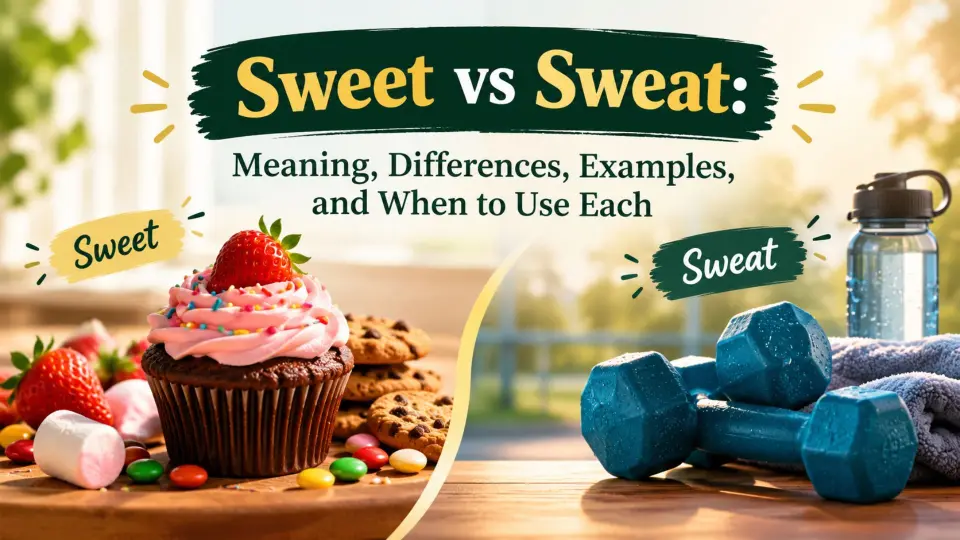
Introduction
The words sweet and sweat look almost identical, but they have completely different meanings. Because they differ by only one letter, many English learners, students, and even native speakers occasionally mix them up while writing. This simple spelling mistake can change the meaning of an entire sentence.
Understanding sweet vs sweat is essential for clear communication. One word describes pleasant taste, kindness, or something enjoyable, while the other refers to the body’s natural cooling process or the effort involved in hard work. Confusing the two can make professional writing, school assignments, emails, and social media posts look careless.
Learning the difference is much easier than it seems. Once you recognize the meaning, pronunciation, and common usage of each word, choosing the correct one becomes almost automatic.
This guide explains sweet vs sweat in simple language, provides practical examples, comparison tables, memory tricks, and real-life situations so you can use both words confidently every time.
The Core Rule Explained Simply
The easiest way to remember sweet vs sweat is to focus on what each word represents.
Sweet describes something that is pleasant, sugary, kind, lovable, thoughtful, or enjoyable.
Examples include:
- Sweet candy
- Sweet music
- Sweet smile
- Sweet memories
- Sweet child
Sweat, on the other hand, refers to moisture produced by the body or the act of producing that moisture during heat, exercise, stress, or physical effort.
Examples include:
- Sweat after running
- Sweat during exercise
- Cold sweat
- Sweat dripping down the face
- Sweat from hard work
Think about the purpose of each word.
If you’re talking about taste, personality, feelings, or something pleasant, the correct word is sweet.
If you’re talking about the body, exercise, heat, nervousness, or physical effort, the correct word is sweat.
That’s the entire rule.
Everything else simply builds on this basic distinction.
Category 1: Sweet
Sweet is mainly an adjective, although it can occasionally function as a noun in certain forms of English.
It commonly describes:
- Pleasant taste
- Kind behavior
- Attractive personality
- Pleasant sounds
- Happy experiences
- Affectionate expressions
Examples:
- The cake is sweet.
- She gave me a sweet gift.
- He has a sweet personality.
- What a sweet message.
- Their baby has a sweet smile.
Category 2: Sweat
Sweat functions as both a noun and a verb.
As a noun, it refers to moisture produced by the body.
Example:
- Sweat covered his forehead.
As a verb, it means to produce perspiration.
Example:
- I sweat a lot during summer.
It can also describe emotional pressure.
Examples:
- Don’t sweat the small stuff.
- She began to sweat before the interview.
Understanding whether you’re describing pleasant qualities or physical perspiration immediately tells you which word belongs in the sentence.
Side-by-Side Comparison Table
| Situation | Example | Meaning | Correct Usage |
| Describing candy | The chocolate is sweet. | Sugary taste | Sweet |
| Talking about exercise | I sweat after running. | Produce perspiration | Sweat |
| Describing personality | She is very sweet. | Kind and caring | Sweet |
| Working outside | His sweat soaked his shirt. | Body moisture | Sweat |
| Talking about music | That’s a sweet melody. | Pleasant sound | Sweet |
| Summer weather | We sweat in the heat. | Perspiration | Sweat |
| Complimenting someone | You’re so sweet. | Thoughtful and kind | Sweet |
| Gym workout | Sweat ran down his face. | Moisture from the skin | Sweat |
| Birthday dessert | The cookies are sweet. | Sugary flavor | Sweet |
| Nervous presentation | I started to sweat before speaking. | Stress response | Sweat |
Deep Dive into Category 1: Sweet
The word sweet has far more meanings than simply describing sugar. Over centuries, English speakers expanded its meaning to include emotions, personality, beauty, sounds, smells, relationships, and experiences.
Let’s explore each use.
Sweet as a Taste
The most common meaning of sweet relates to flavor.
Foods containing natural or added sugar are usually described as sweet.
Examples include:
- Honey tastes sweet.
- Mangoes become sweet when ripe.
- This lemonade is too sweet.
- The cookies are wonderfully sweet.
- That dessert is perfectly sweet.
Not every sweet food contains refined sugar. Fruits, berries, and some vegetables naturally have a sweet flavor.
Here are more examples:
- Fresh peaches taste sweet.
- The pineapple became sweeter overnight.
- These grapes are surprisingly sweet.
- The corn has a naturally sweet taste.
Notice how sweet consistently describes flavor rather than appearance.
Sweet as a Personality Trait
Here’s another common use.
Calling someone sweet usually means they are kind, caring, thoughtful, or gentle.
Examples:
- She’s incredibly sweet to everyone.
- He’s a sweet neighbor.
- Their daughter is very sweet.
- Thank you, that’s so sweet of you.
- My grandmother is the sweetest person I know.
In this context, sweet expresses admiration rather than describing food.
For example:
Instead of saying:
“The teacher is sugary.”
English speakers naturally say:
“The teacher is sweet.”
The meaning shifts from flavor to character.
Sweet in Relationships
The word frequently appears in conversations between family members, partners, and friends.
People use sweet to describe loving actions.
Examples:
- That was a sweet surprise.
- He wrote a sweet letter.
- She gave me a sweet hug.
- What a sweet anniversary gift.
- Their conversation was sweet and heartfelt.
Notice something important.
The object itself does not have to contain sugar.
A handwritten letter is not sugary.
A hug is not sugary.
The word sweet simply means thoughtful, loving, or emotionally touching.
Sweet as a Compliment
Many compliments use sweet because it sounds warm without being overly formal.
Examples:
- You’re so sweet.
- That was really sweet of you.
- You’re the sweetest friend ever.
- She’s incredibly sweet.
- What a sweet thing to say.
These compliments are common in everyday English.
You’ll hear them in schools, offices, families, movies, television shows, and social media conversations.
Sweet for Sounds
Music, voices, and natural sounds are often described as sweet.
Examples:
- She has a sweet singing voice.
- The violin produced a sweet tone.
- Birds sang sweet songs.
- The melody sounded sweet.
- His guitar created a sweet rhythm.
In these examples, sweet means pleasant, gentle, or beautiful.
It has nothing to do with sugar.
Sweet for Smells
Some pleasant scents are also described as sweet.
Examples:
- The flowers have a sweet fragrance.
- The perfume smells sweet.
- Vanilla has a sweet aroma.
- The garden carried a sweet scent.
- Fresh blossoms filled the air with a sweet smell.
Again, the meaning expands beyond taste.
The word now describes something enjoyable to smell.
Sweet in Writing
Authors often use sweet to create warm emotional images.
Consider these examples:
- A sweet childhood memory.
- A sweet reunion.
- A sweet farewell.
- A sweet smile.
- A sweet laugh.
These phrases help readers imagine comfort, affection, happiness, and emotional warmth.
This is why sweet appears frequently in novels, poems, children’s books, and romantic stories.
Sweet in Idioms and Expressions
English contains many common expressions using sweet.
Here are several examples.
Sweet dreams
Meaning:
A kind wish before someone goes to sleep.
Example:
- Good night, sweet dreams.
Home sweet home
Meaning:
Happiness about returning home.
Example:
- After two weeks away, it finally felt like home sweet home.
Sweet tooth
Meaning:
Someone who enjoys sugary foods.
Example:
- I have a serious sweet tooth.
Sweet spot
Meaning:
The ideal position, point, or condition.
Examples:
- We found the sweet spot in the market.
- Hit the tennis ball in the sweet spot.
- This temperature is the sweet spot for baking.
Sweet success
Meaning:
A satisfying achievement after effort.
Example:
- Winning the championship was sweet success.
Common Sentence Patterns with “Sweet”
Learning common patterns makes correct usage much easier.
Here are some of the most frequent sentence structures:
Subject + is + sweet
- The tea is sweet.
- The baby is sweet.
- Your message is sweet.
Sweet + noun
- Sweet memories
- Sweet voice
- Sweet dessert
- Sweet child
- Sweet fragrance
That’s + sweet + of + person
- That’s sweet of you.
- That was sweet of him.
- It was sweet of her to help.
These patterns appear constantly in everyday English and are worth memorizing because they help you recognize the correct word instantly.
Deep Dive into Category 2: Sweat
Unlike sweet, which often describes positive qualities or pleasant experiences, sweat is closely connected to the human body, physical effort, heat, and emotional stress. It can function as both a noun and a verb, making it a versatile word in English.
Here’s the key idea.
Whenever the conversation involves perspiration, hard work, exercise, high temperatures, or even anxiety, sweat is usually the correct choice.
Let’s explore its different meanings and uses.
Sweat as a Noun
The most common use of sweat is as a noun. It refers to the liquid produced by sweat glands to cool the body.
Examples:
- Sweat rolled down his face.
- Her sweat soaked the towel.
- Drops of sweat formed on his forehead.
- The player’s sweat showed how hard he had worked.
- My shirt was covered in sweat after the hike.
This process helps regulate body temperature. Without sweat, humans would struggle to cool down during physical activity or hot weather.
Sweat as a Verb
As a verb, sweat means to produce perspiration.
Examples:
- I sweat a lot in hot weather.
- They sweated through the entire workout.
- She started to sweat after climbing the stairs.
- We sweat during intense exercise.
- He was sweating because the room was too warm.
Notice how the verb changes with tense:
| Tense | Example |
| Present | I sweat easily. |
| Present Continuous | I am sweating now. |
| Past | I sweated during practice. |
| Present Perfect | I have sweated a lot today. |
| Future | I will sweat if it’s this hot tomorrow. |
Understanding these forms helps you write naturally in every situation.
Sweat During Exercise
Exercise is one of the most common situations where sweat appears.
Examples:
- Running makes me sweat.
- Everyone began to sweat during the workout.
- His sweat dripped onto the gym floor.
- The coach encouraged players to embrace the sweat.
- After thirty minutes of cycling, I was covered in sweat.
Athletes often view sweat as evidence of effort and dedication.
You’ll frequently hear expressions like:
- Sweat is progress.
- Earn your sweat.
- Every drop of sweat counts.
These sayings connect perspiration with improvement and persistence.
Sweat in Hot Weather
High temperatures naturally cause the body to produce sweat.
Examples:
- We sweat during the summer.
- The children were sweating in the afternoon heat.
- My hands began to sweat because it was so hot.
- Everyone was wiping sweat from their faces.
- Even standing outside made us sweat.
Weather reports and health articles often discuss sweating as a normal response to heat.
Sweat and Emotional Stress
Here’s something many learners overlook.
People also sweat because of emotions.
Fear, nervousness, embarrassment, and excitement can all trigger perspiration.
Examples:
- I started to sweat before the interview.
- She broke into a cold sweat after hearing the news.
- He was sweating during the exam.
- My palms always sweat before presentations.
- The difficult question made everyone sweat.
In these examples, the body reacts emotionally rather than physically.
Common Expressions with “Sweat”
English includes many popular idioms using sweat.
Learning these expressions makes your English sound more natural.
Don’t Sweat It
Meaning:
Don’t worry about something.
Examples:
- Don’t sweat it, everything will be fine.
- You missed one question. Don’t sweat it.
This expression is common in casual conversations.
Sweat Blood
Meaning:
To work extremely hard.
Examples:
- She sweated blood to finish the project.
- They sweated blood preparing for the competition.
This phrase emphasizes extraordinary effort.
No Sweat
Meaning:
It’s easy or no problem.
Examples:
- Can you help me move this chair?
- No sweat.
Or:
- Fixing the computer was no sweat.
Cold Sweat
Meaning:
Sudden sweating caused by fear, illness, or shock.
Examples:
- He woke up in a cold sweat.
- The accident left her in a cold sweat.
Blood, Sweat, and Tears
Meaning:
Great effort, sacrifice, and determination.
Examples:
- Building the company took blood, sweat, and tears.
- Winning the championship required blood, sweat, and tears.
This is one of the most famous English expressions involving sweat.
Sweat in Professional Writing
Scientific and medical writing often uses sweat precisely.
Examples:
- Sweat helps regulate body temperature.
- Excessive sweating may indicate dehydration.
- Patients reported increased sweating.
- Physical activity stimulates sweat production.
Notice the objective tone.
Unlike sweet, which often carries emotional meaning, sweat in technical writing is usually factual.
The Meaning Shift (or Nuance)
At first glance, sweet and sweat seem confusing because they differ by only one letter. However, their meanings belong to completely different categories.
Here’s the distinction.
Sweet creates positive emotional or sensory images.
Examples:
- Sweet chocolate
- Sweet smile
- Sweet music
- Sweet memory
- Sweet child
These phrases suggest pleasure, kindness, beauty, or affection.
Now compare them with sweat.
Examples:
- Sweat on the forehead
- Sweat after exercise
- Sweat during summer
- Sweat from nervousness
- Sweat after hard work
These expressions describe physical effort or the body’s natural response.
Let’s make this concrete.
Compare these sentence pairs:
- The cake is sweet.
- The runner is covered in sweat.
- She has a sweet personality.
- He began to sweat before the interview.
- The perfume smells sweet.
- The workers were sweating in the sun.
Only one letter changes, yet the entire meaning changes.
This is why proofreading is so important.
Writing:
She has a sweat smile.
sounds incorrect.
Likewise:
I am sweeting after my workout.
is also incorrect.
Understanding the meaning first makes choosing the correct spelling much easier.
Why the Confusion Persists
Many people continue confusing sweet and sweat for several reasons.
Similar Spelling
The two words share most of their letters.
Compare them:
- Sweet
- Sweat
Only one vowel changes, making typing mistakes common.
Fast Typing
People often type quickly on phones or laptops.
Small spelling mistakes easily slip through.
Examples:
- Your message is so sweat.
- I became sweet after jogging.
Spell-check may not catch these errors because both words are correctly spelled English words.
Pronunciation Differences Can Be Subtle
Although the vowel sounds differ, learners sometimes hear them as similar.
- Sweet sounds like /sweet/ with a long ee sound.
- Sweat sounds like /swet/ with a short e sound.
Practicing both aloud improves recognition.
Autocorrect Problems
Some devices replace words unexpectedly.
Typing quickly can create sentences like:
- What a sweat baby.
- I’m sweeting at the gym.
Always reread important writing before sending it.
English Learners Memorize by Appearance
Many learners remember words visually instead of by meaning.
Since sweet and sweat look similar, they may choose the wrong spelling when writing from memory.
Associating each word with its meaning instead of its appearance is much more reliable.
Case Studies / Pop Culture Examples
Real-life examples make the distinction between sweet and sweat even clearer.
Case Study 1: Restaurant Review
Correct:
The chocolate cake was incredibly sweet, and everyone at the table loved it.
Here, sweet describes flavor.
Incorrect:
The chocolate cake was incredibly sweat.
The sentence no longer makes sense because sweat refers to perspiration.
Case Study 2: Fitness Blog
Correct:
After completing the marathon, the runners were covered in sweat.
Here, sweat describes the body’s response to intense physical activity.
Incorrect:
After completing the marathon, the runners were covered in sweet.
This creates an obvious meaning error.
Case Study 3: Romantic Movie Dialogue
Correct:
You’re the sweetest person I’ve ever met.
This compliment highlights kindness and affection.
Incorrect:
You’re the sweatiest person I’ve ever met.
While grammatically correct, it completely changes the intended message and could even sound insulting.
Case Study 4: Children’s Story
Correct:
The little girl shared her sweet smile with everyone she met.
Here, sweet describes warmth and friendliness.
Advanced Scenarios & Flowchart

Some situations may seem confusing at first, especially when writing quickly. Use this simple decision guide whenever you’re unsure.
Text-Based Decision Flowchart
Start here:
Are you describing taste, kindness, affection, beauty, or something pleasant?
→ Yes
Use sweet.
Examples:
• candy
• child
• memory
• perfume
↓
If not,
Are you describing perspiration, physical effort, heat, exercise, or nervousness?
→ Yes
Use sweat.
Examples:
• after running
• on your forehead
• during summer
This simple decision process works for nearly every sentence containing sweet or sweat.
Quick Reference Table
| If You Mean… | Use This Word |
| Sugary flavor | Sweet |
| Kind or caring personality | Sweet |
| Pleasant smell | Sweet |
| Beautiful music or voice | Sweet |
| Loving message | Sweet |
| Body perspiration | Sweat |
| Exercise or workout | Sweat |
| Heat causing moisture | Sweat |
| Nervous perspiration | Sweat |
| Physical effort | Sweat |
| “Don’t worry.” | Don’t sweat it |
| A person who loves desserts | Sweet tooth |
Keep this table in mind whenever you’re unsure. It summarizes the most common uses you’ll encounter in everyday English.
Common Mistakes That Lower Quality
Even experienced English speakers occasionally confuse sweet and sweat. Here are the mistakes that appear most often and how to avoid them.
Mistake 1: Using “Sweat” as a Compliment
Incorrect:
You’re so sweat.
Correct:
You’re so sweet.
A compliment should use sweet, not sweat.
Mistake 2: Using “Sweet” for Perspiration
Incorrect:
I was covered in sweet after the game.
Correct:
I was covered in sweat after the game.
Whenever the sentence refers to body moisture, choose sweat.
Mistake 3: Mixing Up Pronunciation and Spelling
Many learners hear the words quickly in conversation and spell them based on sound instead of meaning.
Remember:
- Sweet has the long ee sound.
- Sweat has the short e sound.
Say both words aloud several times to reinforce the difference.
Mistake 4: Forgetting the Meaning Before Writing
People often focus on spelling first.
A better approach is to ask:
“What am I actually describing?”
If the answer is kindness or pleasantness, use sweet.
If the answer is perspiration or physical effort, use sweat.
Meaning comes before spelling.
Mistake 5: Trusting Autocorrect Too Much
Autocorrect cannot always identify the intended word because both sweet and sweat are correctly spelled English words.
For example:
- What a sweat message.
- I began to sweet after running.
Both sentences contain valid English words, but the meanings are wrong.
Always proofread important emails, assignments, reports, and social media posts.
Memory Hacks That Actually Work
Simple memory tricks can make the difference between sweet and sweat unforgettable.
Hack 1: Double “E” Means Enjoyable
The word sweet contains two e letters.
Think:
E = Enjoyable
If something is enjoyable, pleasant, kind, or delicious, choose sweet.
Examples:
- Sweet cake
- Sweet friend
- Sweet music
Hack 2: Sweat Starts with “Sw” Like Sweatshirt
People often wear a sweatshirt while exercising or when warming up.
Exercise leads to sweat.
Connecting these words helps reinforce the meaning.
Hack 3: Picture the Situation
Create a mental image.
Imagine:
- A birthday cake = Sweet
- A runner crossing the finish line = Sweat
Visual memories are often stronger than spelling rules.
Hack 4: Ask One Simple Question
Before writing, ask yourself:
“Am I describing something pleasant or someone’s body?”
Pleasant?
Use sweet.
Body?
Use sweat.
This single question solves most mistakes instantly.
Hack 5: Match the Common Partners
Certain words naturally pair with sweet.
Examples:
- smile
- dreams
- voice
- dessert
- memories
Other words naturally pair with sweat.
Examples:
- glands
- drops
- soaked
- poured
- dripping
Learning these natural combinations makes correct usage automatic.
Why Precision Matters (SEO/Authority)
Choosing the correct word is more than a grammar exercise. It affects how readers perceive your writing and your credibility.
Better Readability
Correct word choice helps readers understand your message immediately.
Compare these examples:
Incorrect:
She gave me a sweat birthday card.
Correct:
She gave me a sweet birthday card.
The corrected version communicates the intended meaning without confusion.
Professional Credibility
Spelling mistakes involving commonly confused words can make professional documents appear less polished.
Whether you’re writing:
- Business emails
- Blog posts
- Academic essays
- Product descriptions
- Marketing copy
Using sweet and sweat correctly reflects attention to detail.
SEO Benefits
Search engines prioritize content that is clear, accurate, and helpful.
Using the correct word:
- Improves readability
- Reduces user confusion
- Increases trust
- Enhances content quality
- Supports topical authority
Although search engines understand some spelling errors, consistently accurate writing creates a better user experience, which is an important factor in long-term SEO success.
Improved Communication
A single misplaced letter can completely change the meaning of a sentence.
Compare:
- She has a sweet personality.
- She has a sweat personality.
The first sentence is a compliment.
The second sentence is incorrect and confusing.
Small details create a big difference.
A Quick Quiz
Fill in the blanks with sweet or sweat.
- The strawberries were incredibly __________.
- I started to __________ after running five miles.
- She always leaves such a __________ note on my birthday.
- Drops of __________ rolled down the player’s forehead.
- My grandmother has a __________ smile that makes everyone feel welcome.
- Don’t __________ the small stuff.
- The flowers filled the room with a __________ fragrance.
- After working outside all afternoon, his shirt was soaked with __________.
Quiz Answers
- Sweet
- Sweat
- Sweet
- Sweat
- Sweet
- Sweat
- Sweet
- Sweat
Conclusion
Mastering sweet vs sweat also strengthens your overall communication skills because it encourages careful word choice and attention to context. Readers quickly notice accurate language, and consistent correctness builds trust whether you’re creating blog posts, academic assignments, business content, or social media updates. Remember the simple rule: sweet belongs to pleasant experiences, while sweat belongs to physical perspiration and effort. Review common examples, practice the sentence patterns, and use the memory tricks whenever you’re unsure. With regular practice, choosing the correct word becomes automatic, allowing your writing to remain clear, professional, and easy to understand in every situation.
Frequently Asked Questions
What is the easiest way to remember the difference between sweet and sweat?
The easiest method is to connect each word with its meaning. Sweet relates to pleasant things such as desserts, kind people, beautiful music, and happy memories. Sweat relates to perspiration, exercise, hot weather, and physical effort. If your sentence describes something enjoyable, use sweet. If it describes body moisture or hard work, use sweat.
Can sweet and sweat ever be used interchangeably?
No. Sweet and sweat are completely different words with different meanings and grammatical uses. Replacing one with the other changes the meaning of a sentence and often creates an obvious error. Even though they look similar, they are never interchangeable in standard English, so always choose the word that matches the intended context.
Is sweat only related to exercise?
No. While exercise is a common reason people sweat, the word also applies to hot weather, illness, nervousness, fear, anxiety, and other situations where the body produces perspiration. It can also appear in expressions like Don’t sweat it, where it means “don’t worry,” rather than referring to physical perspiration.
Can sweet describe something other than food?
Yes. Sweet is frequently used to describe personalities, voices, smiles, memories, gestures, messages, fragrances, and music. In these cases, it means kind, pleasant, gentle, or enjoyable instead of sugary. This broader meaning makes sweet one of the most versatile descriptive words in everyday English.
Why do spell-check tools sometimes miss sweet and sweat mistakes?
Spell-check programs usually verify whether a word is spelled correctly, not whether it fits the sentence’s meaning. Since both sweet and sweat are valid English words, the software may not recognize that you’ve selected the wrong one. Reading your sentence carefully before submitting it is the best way to catch these errors.
What does the expression “Don’t sweat it” mean?
Don’t sweat it is an informal English expression that means “don’t worry about it” or “it’s not a big problem.” Native speakers use it to reassure someone after a mistake or to encourage them not to stress over something minor. It is one of the most common idioms containing the word sweat.
How can I improve my accuracy when using sweet and sweat?
Practice reading and writing sentences that use each word in different contexts. Pay attention to common word combinations such as sweet smile, sweet dreams, sweat glands, and cold sweat. The more examples you see, the more naturally you’ll recognize which word belongs in each sentence.
Are sweet and sweat pronounced differently?
Yes. Sweet has a long ee vowel sound, while sweat has a short e vowel sound. Although their spellings are similar, the pronunciation difference helps distinguish them. Practicing both words aloud can improve both your speaking and spelling accuracy.
